
All DATTA GURU Places.
Kuravpur:
Introduction.
Bhagwan Shri Dattatrayas Kaliyuga’s first incarnation is SHRIPAD SHRIVALLABH. His place of birth is PITHAPURAM (East Godavari). His working land (Karma Bhumi) & TAPSYA BHUMI is Shrikshetra Kuravpur, Dist. Raichur (Karnataka). His work and greatness is described in Dattatraya’s Holy Book GURUCHARITRA in its Chapter No. 5 to 10. SHRIPAD SHRIVALLABH, himself lord incarnation staying there for upliftment of people and his behaviour made Shrikshetra Kuravpur a sacred land and holy place. The person who is fortunate enough to visit the land and take darshan will experience the calmness. It will be great experience of its kind in his life.
| Kuruvapur is a famous place of lord Dattatreya. It is situated in the state of Karnataka In India.The first incarnation of Lord Dattatreya in kaliyuga is Sripada Vallabha. The birth place of Sripada vallabha is Pithapuram which is situated in Godavari district of Andhra Pradesh. He was taken his birth in the family of Appalaraju Sarma and Sumathi. He has performed penance at about 35 years for Gnana, Viragya siddhi at Kuravapur and closed his avathara On Ashweeja bahula dwadasi (Hastha star) in Krishna river of Kuravapur . The day is known as “GURUDWADASI”. But till today he is in sukshma rupa there and giving indirect darshan to the devotees who are having full faith on him. This place Is termed as Gurudweepa in Scanda purana. | |
| Scanda purana explained that 28000 yogis and siddhis of Himalayas were visited this place and had darshan of lord Dattatreya. This place was named as Kuruvalaya in the days of Nizam government Period. The place is completely surrounded by Krishna river and is called as Dweepa. Tembe swamy majaraj (Sri Vasudevananda saraswathy) performed “Chaturmasya vratha” here in the year of 1911.The disciples of Tembe swamy Sri Rangaavadhootha, Gunavani maharaj were also performed penance here. | |
| Information of KuravpurSHRIKSHETRA KURAVPUR is in Karnataka State, Dist. Raichur. It is situated on the Banks of Krishna River, 25 Km from Raichur. It is an island surrounded by holy waters of rivers Krishna. SHRIKSHETRA KURAVPUR is also known as KURGUDDI. This holy land is donated by a Rajak devotee. Since it is donated to temple priest, it is called AGRAHAR Temple is built as per Hemad Pandit Style. Old Banyan Tree, Audumbar, Gaytri Suryodasana and Cave where his holyness Sripad Srivallabh has done Dhyna. Now the cave has been refurnished and Nirgun Paduka (Foot Print) are kept for Darshan. Nagarkhana has been built by SHRI TUKDOJI HOLKAR. PARAMPUJYA VASUVANANDA SARASWATI MAHARAJ came to this place in 1911 (Vaishakh Shukla 6.) Maharaj did his 21st Chaturmas during his stay. A scorpion bite him when he missed his daily stostra offering prayers to shripad Shrivallabh is also one of the attractions. Mandir Utsav and religious rites performed here are a legacy of Parampujya Vasusanand Sarawati Maharaj. Parampujya Shridhar Swami has also stayed here. In the recent times Dattasam ptradayees Parampugya Gulavani Maharaj, Rangavdhut Maharaj, Nana Maharaj Taranekar, Mama Deshpande have done the Tapasya at this holy place. Recent period Datt Bhakta Also completed the construction work in Puratan Vatvruksha & also Audumbaras. Construction work of Shivaling and caves narrow point, part rooms also constructed for “Sadhakas”. P.P. Vasudevanand Saraswati Dharamsala is also constructed. Shridhar Bhavan constructed work is completed. | |
Daily Programme
- Early Morning 4.30 Kakad Aarti
- Early Morning 5 to Noon 12 Puja 1 Abhishek, Noon Mahaprasad
- Evening : Palkhi & Shejarati.
Route to Kuruvapur
This is about 30 kms distance from the district head quarter Raichur of Karnataka. There is bus facility from Raichur to Aathkur which is 1.5 hours journey. From Aathkur to Kuruvapur, every Person has to travel in Krishna river for 20 minutes in small boats or “butti”. (charge around 15 to 20 rupees).The connection Conveyance facility is available for each bus reaching Aathkur.
Second route: This is about 2.50 hours journey from the district headquarter Mahaboobnagar of Andhra pradesh. Mahaboobnagar is about 2.50 hours journey from state capital Hyderabad . The persons can catch direct buses from Hyderabad to Raichur and have to get down at Makthal. From Makthal to Kurugadda (kuravapur) autos and jeeps Are available. The devotees have to engage an auto or jeep to reach Krishna river. From there also buttis and small boats Are available to reach temple.
Railway
Raichur Station is the Nearest Destination. To get down at Raichur Station then go to Bus stand. From bus stand go to Atakur at 7.30 morning & 11 am. only two bus is available From Village we have to go from bullock cart, boat and sand (walking) we come to Kuravpur Temple. Following are some important trains coming to Raichur.
6011 CST Madras 14.00pm
1081 Kanyakumari 3.35pm
2163 Chennai Express 8.20pm
Narsobachi Wadi (Narsobawadi) Sri Kshetra
Sri Kshetra Narsobachiwadi or Narsobawadi is approximately 22 kilometers from Sangli city in Maharashtra State.
From Guru Charitra Chapter 19: “I am leaving my Padukas here. I will be ever present where my Padukas are worshipped. Whatever wishes to be prayed for, offering worship to the Padukas, they will be granted and fulfilled.” – Sri Narasimha Saraswati.
Following is an extract from Guru Charitra Chapter 18:
Sri Narasimha Saraswati visited the Pancha Ganga Sagar, which is the confluence of the five holy rivers, Siva, Bhadra, Kumbhi, Bhagwati and Saraswati, where they all meet and merge in the Krishna river. Here is the temple of Amareshwar and hence the place is called as Amarapur. Nearby is the Sakti Teertha, where reside Sixty-four Yogini Shaktis, serving and worshipping Amareshwar, but unseen by others. Nearby was Papa Vinasini and other holy Teerthas. Sri Krishna Saraswati stayed at Amarapur for 12 years. This place came to be later called as Narsobawadi (Narsobachi Wadi), after Sri Narasimha Saraswati.
How to reach Narsobawadi (Narsobachi Wadi)
Nearest Train Station is JaiSinghpur which is 5 kms from Sangli Railway Station.
Sangli city to Narsobachiwadi Distance 22 kms.
JaiSinghpur to Narsobachiwadi Distance 14 kms.
Sangli ‘City Bus’ fare to Narsobachiwadi is approx. Rs.15 /-
Private Jeeps/Trax/Sumo are also available from Sangli.
****************************************************************************************************************************************
Sri Kshetra Amrapur (Amareshwar)
It is approximately 23 kilometers from Sangli city in Maharashtra State.
Following is an extract from Guru Charitra Chapter 18 :
Sri Kshetra Gangapur,

One of the most famous Dattatreya Peethas, is associated with Sri Narasimha Sarasvati Swami, an incarnation of Lord Dattatreya. It stands on the bank of the river Bhima in Afzalpur taluka in Gulbarga district of Karnataka. This Nirguna Math is adorned with the Nirguna Padukas. The water of the rivers Bhima and Amaraja, especially at the spot of their confluence, are considered extremely holy.
More about Gangapur and Sri Narasimha Saraswati can be read in Guru Charitra.

Below is extract from Guru Charitra Chapter 15
“Bhima-Amarja Sangam at Gangapur, is very sacred. There are Koti Theerthas there. The Aswatha Tree at Gangapur is as powerful as tha KalpaVriksha. Near the Aswatha Tree is Narasimha Teertha, and northwards to it are the PapaVinasini Teertha, Varanasi Teertha, Rudrapada Teertha, Chakra Teertha, Koti Teertha, manmadha Teertha etc. There is the Kalleshwara temple there. It is holy as Gokarna.”
“Sri Narasimha Saraswati lived in Gangapur continously for a period of 24 years” from Guru Charitra Chapter22.
How to reach Gangapur.
The Train Station at Ganagapur is called as ‘Ganagapur Road’.
Mumbai to Ganagapur Rail Distance – 526 Kms
Mumbai to ‘Ganagapur Road’ Rail 2nd Class Fare – Rs.232/-
Mumbai to ‘Ganagapur Road’ Direct and most convenient Train is 1013 Dn L.T.T. Kurla Terminus
Coimbatore Express, which departs from Kurla Terminus at 10.10 PM & departs from Kalyan 11.15 in the night. It reaches Ganagapur at 8.08 in the morning next day.
From ‘Ganagapur Road’ to Ganagapur City (town), where Datta Mandir is situated is around 30 minutes journey by road. Trax/Jeep/Sumo drivers charge Rs 15 Per Passanger. It takes around 2 hours maximum for a family to perform Pooja/Abhishek at Ganagapur. Local people arrange for accomodation, bath and if required food also, on pay basis.
Nearest City is GULBARGA : 40 Kms.
Gangapur to Sholapur Distance: 94 km (approx.)
Gangapur to Sholapur State Transport (S.T) bus fare – Rs.45/-
Gangapur to Sholapur bus travel time – 3 hours.
***************************************************************************************************************************
Mahur (Mahurgad)
Mahur is a well known religious place and a birth place of Lord Dattatray, which is visited by thousands of devotees and pilgrims throughout the year. The ancient Mahurgad Fort constructed in the 12th century, is just two and a half kms. from the place. There are many temples in Mahur like Anusaya Temple, Kalika Temple. The most important one is the temple of Renuka Devi, which has a special place in the Hindu pilgrimage. A big fair is held here every year on the occasion of Vijaya Dashami (Dassera).
Shri Nrusimha Saraswati Gurumaharaj is the 2nd avatar (incarnation) of Lord Dattatreya. Born in Karanja, He travelled far and wide in what are now known as the States of Maharashtra, Karnataka, and Andhra Pradesh. He achieved Sainthood and performed several miracles. He imparted spiritual knowledge to his disciples, many of whom themselves attained Sainthood.
The Gurumandir Temple conducts several major events to celebrate the various avatars of Lord Dattatreya. Over the past 70 years, Gurumandir has become a nucleus for religious and social welfare activities in the North Maharashtra (Vidarbha) region.
Karanja is located in North-Central Maharashtra in Washim District. It lies just off the main State Highways connecting Shegaon, Nagpur, Amravati, Akola, Aurangabad, Nanded, and Adilabad. It is just 30 kilometers from the main Central Railway line from Mumbai to Howrah (via Nagpur).
The nearest broad-guage railway stations to go to Karanja are Murtijapur and Akola. These are located on the rail route between Mumbai and Howrah (via Nagpur).
Accomodations
Dharamshala (Lodging/Boarding House) The Gurumandir Temple Trust operates a Dharamshala (Lodging/Boarding house) for out-of-town visitors to the temple. This is located just across the temple and is free of cost to the devotees.
Temple Priests
It is not uncommon for the temple priests to invite visitors to stay at their homes for short periods of time. Please provide advance notice of your visit so arrangements can be made.
***************************************************************************************************************************
Pithapur
- Sreepad spent his whole childhood in pithapur
- Lord Dattatraya (kukuteshwar) a very powerful temple located in pithapur.
- All Sreepada miracles were carried in Pithpur.
- He always used to take rest under Audumber Tree.
- As per his instructions, Paduka and his Idol are located at his birth place.
- He gave assurance to humankind though who will visit and carry out worship he shall be blessed by him.
- Those who will help to develop the Mahasanstanam and donate or worship through way of feeding food, financial help or read Sreepada Charitramurtam he will get Abhi Shiddhi.
- Those who worship in Chitra Nakshatra in his place he will get his karma.
- Those who wish to get married he will get benefit and will get married early.
- Those who are visiting Pithapur on Nearly Purnima (Rakhsha Bandhan day) in shravan month they will be blessed by him and he will instruct Chandragupt to write all good efforts you have done in life. It is only by his permission one can visit in this auspicious day else no one can visit Pithapur.
- Those who are suffering from ghosts, black magic or any other external evil effects that will get reduced by visiting this place.
Datt Guru Avatar & their rare details. ( These details are mentioned in Guru Charitra also )
| Avatar | Parents | Birth Place | Home Town | Vesh | Jayanti |
| Shri Guru Datatarey | Anyusa – Atri | Mahur (Nanded) | Girnagar (Saurashtra) | Avdoot | Margashish 15 |
| Sree Guru Sreepad Sreevallabha | Sumati -Appalraja | Pithapur (A.P) | Kuruguddi (Kuravpur-Karnataka) | Bhramachari | Bhadrapad 4 |
| Shri Guru Narshinasaraswati | Amba – Madhav | Lad Karanja (Akola) | Narsobawadi, Audumber, Gangapur | Sanyasi | Paush 2 |
Kardali Ban :
This is located in remote area surrounded by jungle and mountains. here no accommodation or means of transport is available. Not a single lodge to stay or shops are there. One has to carry each and everything with him while traveling here. From Shailayam you have to travel by boat to reach here and then should walk through hills and jungle. The road is between jungle where you shall find many wild animals too, for old people this is very tough to climb up and down. Approximately travel distance as follows:-
1.Shailya to Pathal ganga one can travel by road.
2.From Pathal ganga to Venkatesh Kinara its approximate 22 km’s 1-2 hrs.
3. From Venkatesh Kinara one has to travel by foot and climb hilly area and reach caves which are there its approximate 5-7 hrs journey. Usually people travel her in large groups this cave can accommodate around 200 people. One has to take food, torches, candles or any other required things while traveling. While traveling here one has to climb up and down around 6 hills with thick forest.
4. From this cave Kardali Ban ( where swami were sighted first) is approximate 4 hrs.
5. From Akal devi cave to Kardali Ban its 4 km’s to reach another small cave here one can find Lord Shankara.
6.These all caves are approximately 100ft long and 30ft wide, and 10ft height.Here in one cave you can see Lord Narshima Saraswatis idol which is 2ft. Also Akkamahadevi, Mallikarjun, Nagarjun.
7. On way through jungle you can view cattle’s grazing and also big anthills. From one of these anthills Akkalkot’s Swami Smarth had appeared.
8. On sixth hill there is one big water hole.
SREEPADA’S FAMILY :-
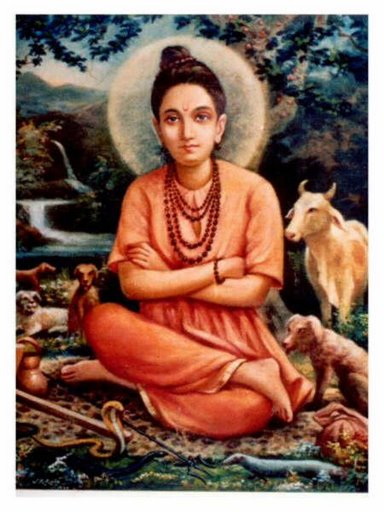
| It is observed that no Sattapurush is born or came into world in regular path of human being. Sreepada appeared in form flame entering this world. His mother’s name was Sumati Maharani & fathers name was Appalaraju Sarma. During maternity time of sumati she fainted and wonderful sound was heard from sky by all people gathered there and asked them to leave the room. When Sreepada Sreevallabha was born, a cobra with three hoods was holding its hoods as an umbrella. He was kept for 18 days. He came out of the mother’s womb as a dazzling illumination.Sumati Maharani fainted immediately after he was born. Auspicious musical notes from musical instruments were heard from the labour room. After some time an invisible voice warned all people to leave the room. Four vedas, eighteen puraanas, great persons arrived in the shape of brilliant lights to Great Sreepada. Sacred Vedic mantras were heard outside the room. Silence spread after sometime. | ||
During early morning Sreepada used to have milk from his
mother sitting in her lap. In afternoon his mother used to feed him
cod rice and sometimes wheat mixed in milk.
|
||
Grandfather – Bapannavadhlu
Father – Appalaraju Sarma
Mother – Sumati Rani
Elder brother – Sreedhar Raj Sarma (Was blind)
Younger brother – Ramraj Sarma (was handicapped)
Three Sisters – Sree Vidhayadhari, Radha & Surekha
| Name of the incarnation |
Name of the father |
Name of the mother |
Period of birth |
Native Village |
Site of the mission |
Total surrender |
Renunciation of the body |
| 1. Shripad Shrivallabh |
Apalraj | Sumatibai | Shake 1245 |
Pithapur (Andhra Pradesh) |
Andhra Pradesh |
At 7 years |
Twelfth day of the dark fortnight of Ashwin Shake 1275 |
| 2. Shri Nrusinha Sarasvati |
Madhavrao | Ambasati | Shake 1339 |
Karanja (Vidarbha) |
Gangapur (Karnataka) |
At 12 years |
Third day of the bright fortnight of Magh Shake 1380 |
| 3. Shri Manik- Prabhu |
Manohar- pant |
Bayamma | Shake 1739 |
Ladvanti (Karnataka) |
Maniknagar | In child- hood |
Tenth day of the bright fortnight of Margashirsha Shake 1787 |
| 4. Shri Swami Samarth (Akkalkot) |
Unknown | Unknown | Unknown | Unknown | Akkalkot (district Solapur) |
Unknown | Thirteenth day of the dark fortnight of Chaitra Shake 1800 |
| 5. Shri Saibaba |
Unknown | Unknown | Unknown | Pathari | Shirdi | Unknown | Tenth day of the bright fortnight of Ashvin Shake 1839 |
| 6. Shri Bhalchandra Maharaj |
Parshuram | Anandibai | Shake 1825 |
Mhapan | Kankavli (district Sindhudurga) |
At 22 years |
Seventh day of the bright fortnight of Margashirsha Shake 1899 |
Implied meaning of the family
- The cow (behind the idol): The earth
- The four dogs: The four Vedas
- The holy fig tree (oudumbar): A symbol of Datta, worthy of worship as the Datta principle exists in it in a greater amount.


 The village itself is named after the deity of this temple. The main
deity here is Lord Narasimhar. This is a beautiful rock cut temple. The
temple and even the deity is carved out of a small hillock. Here the
Lord is known as Sri Paatalaadri Narasimhar. In Sanskrit Paatalaadri
means a reddish hill. The original name of this place itself is
Paatalaadripuram.
The village itself is named after the deity of this temple. The main
deity here is Lord Narasimhar. This is a beautiful rock cut temple. The
temple and even the deity is carved out of a small hillock. Here the
Lord is known as Sri Paatalaadri Narasimhar. In Sanskrit Paatalaadri
means a reddish hill. The original name of this place itself is
Paatalaadripuram. According
to temple sources, this temple has been referred in Brahmaanda
Puraanam. Lord Vishnu took the form (Avataar) of Sri Narasimha and
killed the demon king Hiranyakasipu. At the time of Narasimha Avataar,
this place was surrounded by dense forests. A sage called ‘Jaapaali’ was
performing Thapas, praying Lord Vishnu. As wished by him, the Lord gave
dharshan to him in the form of Ugra (fierce) Narasimhar.
According
to temple sources, this temple has been referred in Brahmaanda
Puraanam. Lord Vishnu took the form (Avataar) of Sri Narasimha and
killed the demon king Hiranyakasipu. At the time of Narasimha Avataar,
this place was surrounded by dense forests. A sage called ‘Jaapaali’ was
performing Thapas, praying Lord Vishnu. As wished by him, the Lord gave
dharshan to him in the form of Ugra (fierce) Narasimhar. The
main sanctum itself is a rock cut shrine on which the deity too is
carved out of the hill itself. So, whoever wants to circumambulate
around the temple has to actually go around the small hillock as Giri
Pradhakshinam. Hence, Giri Pradhakshinam is very popular here.
The
main sanctum itself is a rock cut shrine on which the deity too is
carved out of the hill itself. So, whoever wants to circumambulate
around the temple has to actually go around the small hillock as Giri
Pradhakshinam. Hence, Giri Pradhakshinam is very popular here. There are Bali Peetams seen at certain directions, while going around the temple.
 While
walking around the temple, there is an Azhinjal tree in this temple,
which is considered most sacred. It is said that this tree has mentions
in the ‘Naachiyaar Thirumozhi’ composed by Sri Aandaal. People praying
for marriage or children tie a small piece of thread from their clothes
on the branches of this tree. By doing this with a wish, it is believed
that their wishes are granted.
While
walking around the temple, there is an Azhinjal tree in this temple,
which is considered most sacred. It is said that this tree has mentions
in the ‘Naachiyaar Thirumozhi’ composed by Sri Aandaal. People praying
for marriage or children tie a small piece of thread from their clothes
on the branches of this tree. By doing this with a wish, it is believed
that their wishes are granted. Sri Anjaneyar (Hanuman) is seen on the pillar adjacent to Dwajasthambha, where many people light Ghee lamps for the God.
 While
entering into the street of this temple, there are 4 pillars welcoming
us, which look too ancient having beautiful sculptures.
While
entering into the street of this temple, there are 4 pillars welcoming
us, which look too ancient having beautiful sculptures. The Theertham for this temple is called Suddha Pushkarani and Sthala Viruksham is Paarijaatham.


 It
is said that Sri Vinayagar (Lord Ganesha) worshipped the Goddess here
by performing Abhishegam using Valampuri Sanghu (Conch). The Goddess got
pleased with His worship and blessed Him that the poojas at the temple
will first be performed to Sri Vinayagar and then to Her. Sri Vinayagar
can be seen present in the temple just as we enter the temple near the
Dhwajasthambham. While entering the temple, one has to pray Him and then
go further to worship Sri Karumaari Amman.
It
is said that Sri Vinayagar (Lord Ganesha) worshipped the Goddess here
by performing Abhishegam using Valampuri Sanghu (Conch). The Goddess got
pleased with His worship and blessed Him that the poojas at the temple
will first be performed to Sri Vinayagar and then to Her. Sri Vinayagar
can be seen present in the temple just as we enter the temple near the
Dhwajasthambham. While entering the temple, one has to pray Him and then
go further to worship Sri Karumaari Amman. Thiruverkaadu
is the place where all 3 Gods, Brahma, Vishnu and Shiva have worshipped
the Goddess. Hence She is called as Sri Karumaari here. Ka means
Brahma, Ru means Rudhra or Shiva, and Ma means Vishnu.
Thiruverkaadu
is the place where all 3 Gods, Brahma, Vishnu and Shiva have worshipped
the Goddess. Hence She is called as Sri Karumaari here. Ka means
Brahma, Ru means Rudhra or Shiva, and Ma means Vishnu. The
temple here is facing east. There is a beautiful Rajagopuram to enter
the temple. Once we enter Sri Vinayagar is seen on an elevated shrine
under a tree.
The
temple here is facing east. There is a beautiful Rajagopuram to enter
the temple. Once we enter Sri Vinayagar is seen on an elevated shrine
under a tree. Sri
Subramanyar is found at the praakaaram around the sanctum. Navagrahas
are found at the north eastern side of the temple. Sri Brahma is found
on one of the walls facing north.
Sri
Subramanyar is found at the praakaaram around the sanctum. Navagrahas
are found at the north eastern side of the temple. Sri Brahma is found
on one of the walls facing north.
 There
is another small shrine adjacent to this temple, where a huge ant hill
is found under a Peepul tree. Devotees offer milk and eggs for the
snakes in this ant hill. Camphors are also lit here to offer worship.
The entire ant hill is yellow in color as devotees have applied turmeric
powder on it.
There
is another small shrine adjacent to this temple, where a huge ant hill
is found under a Peepul tree. Devotees offer milk and eggs for the
snakes in this ant hill. Camphors are also lit here to offer worship.
The entire ant hill is yellow in color as devotees have applied turmeric
powder on it. The temple pond is found in front of the temple which is so beautiful with a small Mandapam in the middle.
 A tall and beautiful temple Chariot is parked in a separate Mandapam adjacent to the temple.
 Thiruverkaadu
attracts thousands of devotees and tourists everyday from various parts
of the country. Sri Ambaal here is believed to be so powerful granting
the wishes of the devotees worshipping her
Thiruverkaadu
attracts thousands of devotees and tourists everyday from various parts
of the country. Sri Ambaal here is believed to be so powerful granting
the wishes of the devotees worshipping her Sabarimalai is situated amidst the dense forests in Sahya hill
(Sahyadri) range in Pathanamthitta District of Kerala. The temple
(Sannidhanam) is located on the hill top, at an altitude of 4135 ft.
Sabarimalai is situated amidst the dense forests in Sahya hill
(Sahyadri) range in Pathanamthitta District of Kerala. The temple
(Sannidhanam) is located on the hill top, at an altitude of 4135 ft.


 Even
today, no abhishekams are performed to the Sri Chakra as it contains
rare herbs. Only Kumkuma Archana is performed that too only to the Sri
Chakra and not the idol, as the powers of Sri Kamakshi Amman has been
instilled in the Chakra by Sri Aadhi Sankaracharya.
Even
today, no abhishekams are performed to the Sri Chakra as it contains
rare herbs. Only Kumkuma Archana is performed that too only to the Sri
Chakra and not the idol, as the powers of Sri Kamakshi Amman has been
instilled in the Chakra by Sri Aadhi Sankaracharya.